user123★★★★★
Only 2d photos working excellent
Only 2d photos working excellent.I dont.Maybe AI needed
Turn flat graphics into 3D-printable STL files. Upload PNG, JPG, WEBP, or SVG — we extrude clean outlines (Logo) or sculpt a heightmap from photos (Relief).
Conversion runs on a temporary worker service to keep this page fast. Treat uploads as transient and avoid sensitive files.
Pick Logo for vector-like artwork (SVG recommended) or Image to sculpt depth from a photo.
This tool uses a server-side service for processing; uploaded files or requests are not kept for long-term storage.
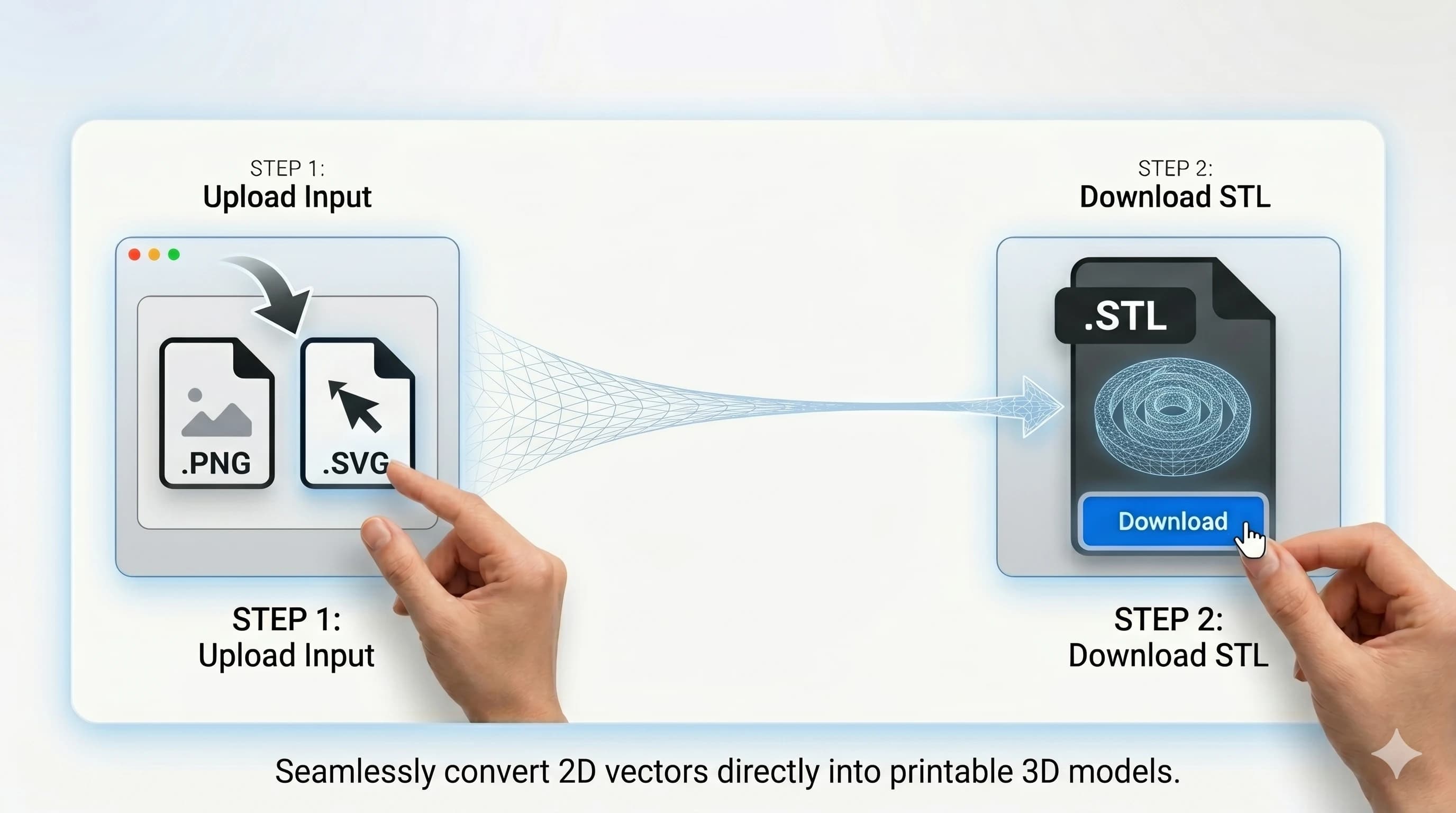
This PNG/SVG to STL converter turns a flat graphic into a simple 3D model by extruding it into thickness. Upload a PNG or SVG, set your target size in millimeters, choose a thickness, and download a ready‑to‑slice STL. It’s a practical workflow for signs, badges, name plates, stamps, and maker projects—not a tool for sculpted, photo‑realistic 3D models.
Sizing is intentionally simple: thickness is required, and you can enter a width and/or height in mm. If you provide only one dimension, the other is derived to preserve aspect ratio. If you provide both, the tool preserves aspect ratio by default and fits the shape inside your width × height box.
SVG usually produces cleaner geometry because it starts as vector paths. PNG is traced from contours, so very noisy images (especially photos, gradients, or blurry edges) can produce rough borders in the resulting STL. For the best results, use high‑contrast artwork with clear silhouettes and simplified shapes.
Tip for printability: keep small details above your printer’s effective resolution. If thin features disappear in a slicer preview, increase the overall size or simplify the graphic. Since STL does not embed units, most slicers assume millimeters—this tool outputs sizes in mm.
Privacy note: conversion is performed by a temporary conversion worker so the main app does not do heavy STL generation. Treat uploads as transient and avoid sensitive files. If a conversion fails, you can retry with the same settings.
If your slicer reports non‑manifold edges or missing faces, try an SVG version of the same artwork (or simplify the PNG), increase thickness slightly, and re‑export. Simple, vector‑like inputs usually produce the most reliable watertight meshes.